Understanding hair loss — a comprehensive guide
What causes hair loss, how it progresses, and what you can do about it. Written by the doctors at Gold Coast Hair Transplant to help you make informed decisions about your hair.
What causes hair loss, how it progresses, and what you can do about it. Written by the doctors at Gold Coast Hair Transplant to help you make informed decisions about your hair.
Starting point
Hair loss is one of the most common medical concerns in Australia, yet it remains widely misunderstood. Many people spend months or years trying over-the-counter products, following advice from friends or social media, or simply hoping the problem will stop on its own — without ever understanding what is actually happening to their hair.
That lack of understanding makes it difficult to evaluate your options clearly. If you do not know what is driving the hair loss, you cannot know which treatments might help, which are unlikely to work, and when doing nothing is perfectly reasonable.
What this guide is: a plain-language walkthrough of the biology behind hair loss, the stages it follows, the differences between men and women, and the range of treatments available — surgical and non-surgical. Our goal is to give you the knowledge to have a genuinely informed conversation with a doctor, whether that doctor is at our clinic or somewhere else entirely.
The biology
There are many reasons hair can thin or fall out — stress, illness, medication side effects, nutritional deficiencies, hormonal changes and autoimmune conditions among them. But the overwhelming majority of hair loss in both men and women comes down to one cause: androgenetic alopecia, more commonly known as pattern hair loss.
Pattern hair loss is driven by a hormone called dihydrotestosterone, or DHT. DHT is produced when the enzyme 5-alpha reductase converts testosterone into its more potent form. In people who are genetically susceptible, DHT binds to receptors in certain hair follicles and gradually causes them to shrink. Each growth cycle produces a thinner, shorter, less visible hair until eventually the follicle stops producing visible hair altogether.
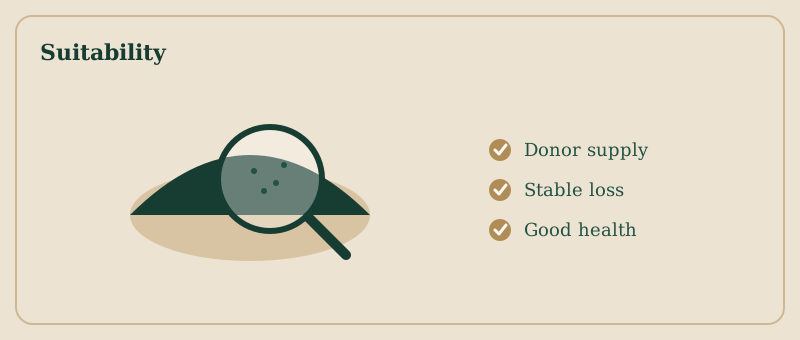
The key word there is genetically susceptible. Not all follicles respond to DHT in the same way. The follicles on the back and sides of the scalp are typically resistant to DHT, which is why those areas retain hair even as the crown and temples thin. This is also why donor hair from those regions is used in hair transplant procedures — it tends to keep its DHT-resistant characteristics after being moved.
Genetics determine whether your follicles are sensitive to DHT, how early the process begins, and how quickly it progresses. The pattern can be inherited from either parent or both, and it is not as simple as looking at your mother’s father (a persistent myth we address later).
Different patterns, different considerations
Androgenetic alopecia affects both sexes, but it presents differently — and that difference matters when it comes to treatment.
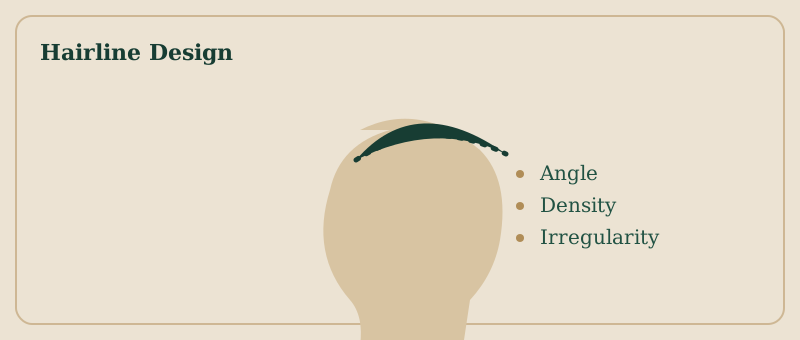
In men, hair loss typically follows a recognisable progression. It usually starts with a receding hairline at the temples, thinning at the crown, or both. Over time these areas may expand and merge, potentially leaving hair only around the sides and back of the head. This progression is mapped by the Norwood Scale, which we describe in the next section.
Male pattern hair loss can begin as early as the late teens or early twenties, though it more commonly becomes noticeable in the late twenties to mid-thirties. The earlier it starts, the more advanced it tends to become over a lifetime, though the rate of progression varies greatly from person to person.
In women, the pattern is usually different. Rather than a receding hairline, women more commonly experience diffuse thinning across the top of the scalp, with the part line gradually widening. The hairline at the front is often preserved. This pattern is sometimes classified using the Ludwig Scale.
Female hair loss frequently coincides with hormonal changes — after pregnancy, during perimenopause, or following changes to contraception. Iron deficiency, thyroid disorders and polycystic ovarian syndrome (PCOS) can also contribute, which is why a thorough medical workup is particularly important for women experiencing hair loss.
Treatment considerations differ too. Certain medications commonly used in men are not suitable for women, and the diffuse nature of female hair loss means transplantation is not always the most effective option.
Measuring progression
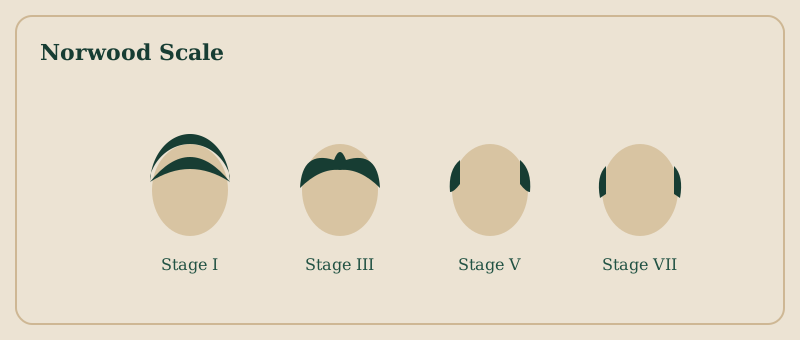
The Norwood-Hamilton Scale is the most widely used classification system for male pattern hair loss. It describes seven stages, from minimal change to extensive hair loss, and helps doctors communicate where a patient sits on the spectrum and plan treatment accordingly.
Understanding where you fall on this scale is useful, but it is important to recognise that not everyone follows a neat linear path from one stage to the next. Some people stay at an early stage for decades; others progress more quickly. Your doctor uses the scale as a reference point alongside other assessments, not as a prediction of what will happen next.
Little or no recession of the hairline. This is the baseline — the control point against which later changes are measured. Most adolescents and young adults sit here.
Minor recession at the temples, sometimes described as a “mature hairline.” This is common in adult men and is not always a sign of progressive hair loss. The distinction between a mature hairline and early balding is one a doctor can help clarify.
Deeper recession at the temples, forming a more visible M-shape or U-shape. For many men, this is the point where hair loss first becomes cosmetically noticeable and the reason they start seeking information.
The hairline recession of stage 3 is accompanied by thinning or a bald spot at the crown (vertex) of the scalp. The two areas of loss have not yet connected.
Further recession at the front and more pronounced thinning at the crown. A band of hair still separates the two areas, but it is narrowing. Hair density across the top of the scalp is visibly reduced.
The band of hair between the frontal recession and the crown is much thinner and may begin to break through. The two zones of loss are starting to merge into a single larger area.
The front and crown have fully connected. Hair remains primarily on the sides and back of the head, in the characteristic horseshoe pattern. Some fine hair may persist across the top but provides little coverage.
The most advanced stage. Only a narrow band of hair remains around the sides and back of the head. The remaining hair may also be thinner than it once was. At this stage, the donor supply for transplantation is limited, and expectations need to be managed carefully.
Recognising the signs
There is no single “right time” to see a doctor about hair loss, but there are signals worth paying attention to. Catching hair loss early gives you more options — and more time to make a considered decision rather than a panicked one.
Consider speaking to a doctor if you notice any of the following:
Receding hairline — your hairline is moving back, particularly at the temples, in a way that is different from a year or two ago.
Widening part — the part in your hair is noticeably wider than it used to be, or your scalp is more visible through the hair on top.
Excess shedding — significantly more hair on your pillow, in the shower drain or on your brush than usual, persisting for more than a few weeks.
Crown thinning — visible thinning or a bald spot at the crown of the scalp that was not there before.
Thinner ponytail — your ponytail feels thinner, or you need more passes of a hair tie to secure it (a common early sign in women).
Sudden or patchy loss — hair loss that comes on suddenly or in patches, which could indicate a different type of hair loss that warrants prompt medical attention.
The purpose of an early consultation is not to push you toward treatment. It is to get an accurate picture of what is happening — whether the loss is progressive or stable, what is causing it, and what your options are if you decide to act.
Your options
There is no single treatment that works for everyone. The right approach depends on the cause, the stage, your goals, and your individual biology. Here is an honest overview of what is available.
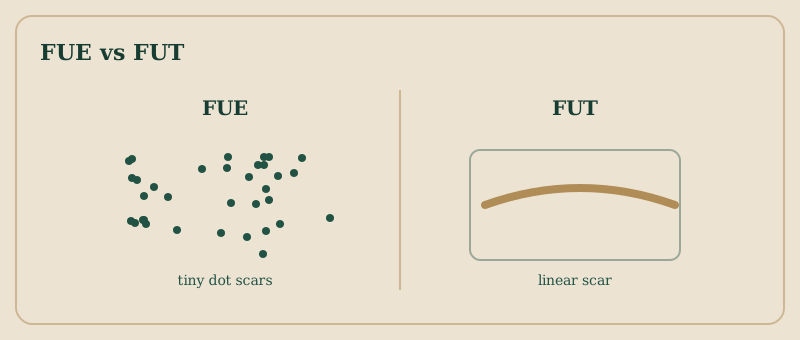
Follicular Unit Extraction (FUE) is a procedure in which individual hair follicles are removed from the donor area — typically the back and sides of the scalp where hair is resistant to DHT — and placed into areas that are thinning or bald.
FUE does not create new hair. It redistributes existing hair from an area of abundance to an area of need. The transplanted follicles retain their DHT-resistant properties, which is why the moved hair tends to persist long-term.
There is no scalpel incision, no stitches and no linear scar. Recovery is relatively quick, and the procedure is performed under local anaesthetic at our Bundall clinic. Results develop gradually over six to twelve months.
Not all hair loss requires — or is best treated with — surgery. Non-surgical approaches can be effective on their own, or they can complement a transplant to protect existing hair and support new growth.
PRP involves drawing a small amount of your own blood, concentrating the platelets, and injecting the platelet-rich plasma into the scalp. The growth factors are thought to stimulate follicles and encourage thicker, healthier growth. Increasingly used to support transplanted grafts or slow thinning where surgery is not yet needed.
Two medications with well-established evidence. Finasteride (oral) reduces the conversion of testosterone to DHT. Minoxidil (topical) prolongs the growth phase and may improve blood flow to follicles. Both require ongoing use and have potential side effects that should be discussed with a doctor.
Often the most considered approach combines treatments — for example, an FUE procedure to restore density in one area while using finasteride and PRP to protect surrounding hair. These decisions are made individually, based on a thorough assessment. Read more →

Sorting fact from fiction
Hair loss is surrounded by misinformation. Some of it is harmless; some of it leads people to waste money on ineffective products or delay seeking proper advice. Here are some of the most persistent myths — and what the evidence actually says.
This is one of the most widespread myths and it is not supported by evidence. Hats do not restrict blood flow to the follicles in any meaningful way, and they do not cause traction-related loss under normal use. If you are losing hair, it is not because of your cap.
Pattern hair loss can begin in the late teens and early twenties. It affects both men and women, across a wide range of ages. By the age of 50, roughly half of men will show some degree of visible hair loss, but the process often begins well before it becomes obvious.
The genetics of hair loss are complex and involve multiple genes from both parents. While the androgen receptor gene on the X chromosome (inherited from the mother) plays a role, it is not the only factor. Looking at your maternal grandfather is not a reliable predictor — your father’s side of the family matters too.
Hair follicles moved during an FUE procedure are taken from areas of the scalp that are resistant to DHT — typically the back and sides. Those follicles retain their genetic characteristics after being transplanted, which means they continue to grow in their new location. The transplanted hair does go through a normal shedding phase in the weeks after the procedure, but this is a temporary part of the growth cycle, not a sign that the transplant has failed.
Washing your hair does not cause follicles to weaken or fall out prematurely. The hair you see in the shower drain was already in the shedding phase of its growth cycle. A healthy scalp actually benefits from regular, gentle cleansing, and avoiding washing out of fear tends to cause more anxiety than it prevents hair loss.
The hair-loss supplement industry is enormous and largely unregulated. While genuine nutritional deficiencies (particularly iron and vitamin D) can contribute to hair loss and should be corrected, most over-the-counter supplements marketed for “hair growth” do not have robust clinical evidence behind them. If a product sounds too good to be true, it probably is. The evidence-based medical treatments are well known — and none of them come in a “miracle” bottle.
Preparing for your visit
A consultation at Gold Coast Hair Transplant is a medical appointment, not a sales meeting. It is your opportunity to get an honest, professional assessment of your hair loss from an AHPRA-registered doctor — and to ask any questions you have without pressure.
Dr Alexander Brooks or Dr Ranadi Vincent will examine your scalp, assess your donor area, discuss your medical history, and talk through what you are hoping to achieve. Using objective scalp-mapping technology, they will measure follicle density and distribution to build an accurate picture of where you stand.
At the end of your consultation, you will have a clear understanding of what is causing your hair loss, whether treatment is appropriate, and if so, which approach suits your situation. If a transplant is not the right option, your doctor will tell you that directly.
There is no obligation to proceed, and no pressure to make a decision on the day.
Bring a list of medications you are currently taking, including supplements and over-the-counter products.
Note any relevant medical history — thyroid conditions, autoimmune disorders, recent surgery or illness.
Bring old photos showing your hair at different ages. These help your doctor understand how your hair loss has progressed over time.
Write down your questions beforehand so you do not forget anything during the appointment.
Come with clean, unstyled hair if possible. Avoid heavy product so your doctor can examine your scalp clearly.
Be honest about your expectations. The more your doctor understands about what you hope to achieve, the better they can advise you.
Take the next step
Book a consultation at our Bundall clinic. Dr Alex or Dr Ranadi will give you an honest assessment — what is causing your hair loss, whether treatment is appropriate, and which approach suits your situation. No pressure, no obligation.